Sunday, 4 March 2012

Pape Sec


I had the early shift with the dogs today, and I was so glad I did.  The pink and white almond blossom both scented and tinted the land, and the sun’s red ball slowly rose from the Mediterranean, but I ended this walk feeling so really angry and guilty too!

My phone had rung as I was nearly back at the casa. It was Pape Sec, my very good Senegalese market trader friend. He was distraught. He was about to set off this morning, to go to market, when he discovered that his battered old van had been broken into, and that his entire stock of handbags had been stolen.


Let me tell you a little about Pape. He’s been in Spain for about 5 years now. He arrived from Senegal on a flight from Dacca to Madrid, and entered the country on a legal visa, which had cost him and his family, what was for them a fortune. They had saved for several years, to raise this. The investment in Pape, was an investment for all the family. Prospects for him to earn any kind of income in Senegal were so poor that the sacrifice of not seeing his family – his mother, wife and two young children for several years (5 years so far) was worth it. The legal visa provided for only one visit. A few of his friends, who arrived here several years ago, now have all the necessary paperwork, and are able to travel back to Senegal by car, and then legally return. When they do, Pape is able to send his family all kinds of small gifts – soap, hand cream, candles, paper and pencils not readily available or affordable there. He has also been able to send money, sometimes 10 Euros, sometimes 20 Euros that have really helped the quality of life of his immediate family, and repay the debt of the visa.
Pape’s dream is that one day he will be able to legally return to Senegal, to see his wife, children and ageing mother. His brother died about 6 months ago. A return to the funeral wasn’t an option! He does accept though that the best he can hope for in life is to be a migrant worker, living far from home, seeing his family just occasionally, but at least able to provide them with a life above subsistence level.

To become legal in Spain, Pape has to fulfil several criteria. He has to be able to prove he has lived here for 3 years. He has to show that he has significant funds in the bank. He also has to show that he is making contributions to the Spanish National Insurance system, either as a self employed person (305 Euros per month and not many traders of any nationality can afford to pay this) or by being an employee of a company. Unemployment in Spain since ‘El Crisis’ (the international financial meltdown), is running well above 20%, so there is virtually no chance of gaining employment other than by occasional ‘unofficial’ agricultural labour. Apparently, it is possible to purchase a ‘contracto’ – paperwork from an ‘employer’ to show that national insurance contributions are being paid by them – but many of these are simply schemes to rip off poor and desperate people.

So in reality, it seems Pape must struggle on. He lives in a flat only intended for two people, but ‘hot bedding’ with 5 others! He must hope that the world wide recession will come to an end soon so that he can get any kind of a wage paying job, or that he can maybe sell just a few more handbags each week for 12 Euros – that he paid 5 Euros for – after travelling 2hours each way to the wholesaler in Elche, at a cost of 40 Euros of diesel – to purchase them! 

And so I feel guilty that my life is relatively uncomplicated. By and large I can afford the ‘necessities’ of life and then some! If I need to return to see family in the UK, I can be there next day – if not sooner.  However, my mate Pape lives on the edge of economic and emotional survival. He strives under the most difficult circumstances to do his best for the family who he has not seen for years, and has little prospect of doing so soon, so that they can have a marginally better life.

And then some ‘low life’ steals his means of survival from him. The handbags they took represent Pape’s very struggling business. Even at the good markets Pape sells very few or even no bags these days, because local people, understandably, are hanging onto their money. The ‘low life’ is probably struggling to survive just like Pape – but that doesn’t stop getting me so angry, that they would harm someone so vulnerable. 

Thursday, 8 December 2011

BELEN


Nearly into mid December and the weather continues to be good. Like the summer before it, that lasted until nearly the end of October, this autumn doesn’t seem to know when to move on. Except from one wet day, that deposited a dusting of snow on the highest peaks of the Sierra Maria, we continue to enjoy sunny days with clear blue skies. ‘Strappy top weather’, as Heather calls it! The forecast is, that it will remain the same, at least until the winter solstice, but no doubt we’ll get our ‘comeuppance’, before too long.

But if the weather doesn’t know when to change to reflect the season, you only need to check in the local shops, to see what time of year it is, and how the year is moving on. In the late summer they all had piles of white paper bags. Yes, white paper bags!  What are they about? Well they’re to put your grape bunches in, so that they can be ripened on the vine, without being damaged by wasps.

These were soon to be followed by the colourful plastic flowers. Right through October and November, most kinds of shops, as well as their normal goods, had plastic flowers for sale. The wholesalers, where I buy my market supplies from, had several rows devoted to nothing else. Then, on All Soul’s Day the extended families, armed with picnics, descended on the cemeteries for the day, to remember their deceased relatives, and decorate their internment niches with these flowers.

Last month, Gallegos’s, where you can buy absolutely anything – apples to ‘Z beds’ - in his rambling four story store, (and if he’s not got it in stock, he’ll have it in a catalogue, that you can order from) had grape presses on the pavement outside. So had Biona, where they had also been accumulating great piles of olive and almond wood for the home fires. Also in Biona were large plastic wrapped bales of straw – seeded with sitas – for a tasty home crop of fungi.

Today, Merito told me that he will pick his olives the first week of January, and sure enough, just now in the shops around here, you will be tripping over short handled plastic olive rakes.  

A couple of years ago, I went to help Mel gather some of his - he has over a hundred trees and that year had been a very good crop. Paco, another friend was there to help him too. Mel and Paco couldn't agree on the best way to collect the juicy black olives onto the nets spread below the trees. Mel favoured an olive rake - he claimed that it dislodged fewer olive leaves that later needed cleaning from the crop, than Paco's more direct approach of beating the branches with a large stick. I actually favoured pulling the strings of olives with my hands, but I always had to watch what Paco was doing with his stick, because I was very likely to end up with broken fingers!

Turón, nut nougat can be bought all the year round, but is really synonymous with Spanish Christmas, when it is found in all kinds of varieties and textures, including chocolate.

As I’ve blogged before http://petesinspain.blogspot.com/2011/01/rambling-on-twelfth-night.html many churches have huge displays to depict the nativity, and here in Oria, a couple of brothers Juan and Miguel, who have been creating a Belen for a number of years have put their latest creation onto ‘youtube’ http://www.youtube.com/watch?v=VWqRRubNRKE&feature=youtu.be&noredirect=1

Saturday, 29 October 2011

An aerie of eagles


Pete is my most lucky visitor, when it comes to eagle ‘experiences’ in the Barranco.

He is a keen walker and visits most years, in October.

Last year, we spotted a route up the mountain to the north east of our Casa. After a short stroll down the 'rambla', we started to ascend the rocky spur that would take us up 400 metres to an altitude of nearly 1300 metres.

In spring the mountain slopes resemble an alpine meadow, but at this time they were covered in purple lavender. Its sweet scent followed us for the entire walk, and we were accompanied by the hum of honeybees, busily working the flowers, even at this altitude and so late in the year. A falcon swooped past, but perhaps even more impressive was the glint of sunshine on the Mediterranean, visible beyond other lower sierras, 25 kilometres away as the falcon flies!


I have never looked down on an eagle before, but today, we spotted two, slowly circling with deep wing beats, above the summit of a neighbouring lesser peak. They must have spotted us too, because they moved off down the 'rambla', only for one of them to reappear minutes later, no more than 20 metres above our heads. It used the strong wind on its huge wings like a kite, to hover there for a couple of minutes. Very clearly, we could see the marking of the golden eagle, the fronds at the ends of its broad wings and the wedge shaped tail. It seemed to look disdainfully down us, as if rebuking us, for having the nerve to look down on it!

It is always a joy to see an eagle in the Barranco, but I feared that after that day's experience, it would never be quite be the same.

But not so! Yesterday evening we saw 13, yes without precedent for me, 13, Golden Eagles circling over the mountain behind the casa. With such a large group, we thought maybe they were vultures, but our binoculars did indeed confirm them as Golden Eagles; as they circled, and came in one by one, to settle on the high cliff top’ to rest and preen themselves and look down on the world as the sun began to set.

So this morning, Pete, John (another visitor) and I decided we were going to try and get a closer look. Off we went with the excited dogs, Millie and Holly, through the hamlet towards the climb up the mountain.  We exchanged ‘holas’ with my neighbours. Jose who said that yesterday, he had seen 6 wild goats at the fuenta. “Perhaps the eagles want to feed on goat,” joked Merito. 

Up we went, and the higher we climbed, the finer the view became. Beyond the foothills of the Sierra de las Estancias towards Partaloa, was the Almanzora Valley and then the Sierras de los Filabres, with the distinctive Mount Tetica,  and the observatory at Calar Alto prominent; and beyond them the Sierra Cabrera with an ultimate vista of the shimmering Mediterranean at Garrucha.

As we ascended we could just make out the eagles peering down on us. Occasionally, one would stretch its massive wings, but while they could curiously see us slowly heading towards their Piedra del Águila,( Eagle Rock) we were sure they wouldn’t move on, until they could see us no more. Sure enough, as we traversed around a rocky slope, that took us out of their view, they set off.
    I know it may be hard to imagine, but the black dots at the centre top of the rock face are eagles

They glided over the Barranco in the direction of Saliente, before catching a thermal that took them far away to the east.

I think I managed to catch 11 of the eagles as they set of on mass towards Saliente


Thursday, 13 October 2011

A Visitor from Portugal


Merito and Francesca were passing by the casa as they returned from harvesting the almonds from some of their trees. Merito is well into his sixties, but the heavy sack of nuts that he carried on his shoulder seemed no effort to him. The work and cultivation of the land has been the perfect gymnasium for my neighbours. No matter their age, they all seem to have so much strength and energy.

He rested the sack and then he and Francesca, excitedly told us that some people from Fatima in Portugal were visiting next Monday afternoon. They were going to go around all the Barranco; stopping at every house; calling in and taking a photo, and this was the first time for 60 years that this had happened!

Now, you probably wouldn’t know it, but the people in these parts don’t really talk Spanish. It’s all together, another language they speak! As far as the rest of Spain is concerned, it’s probably worse than a cross between Geordie and Glaswegian!  So it’s no wonder, that we sometimes wonder, what is really going to happen.

Monday came around and we weren’t a lot wiser; but I had done an internet search on Fatima, and discovered that the place was famous, because a young girl from there, had seen a vision of the Virgin Mary. Could this be something to do with it?

Anyway, our neighbours were really busy preparing a grand olive bower and floral arrangement at the fiesta area, and it turned out that in fact, the statue of the Virgin of Fatima was being brought to the Barranco, for all to see and venerate. 


Now I’m not at all religious, but because my neighbours were so enthused and excited about the event, I cast aside any hypocrisy, and joined in.

The Virgin arrived accompanied by 2 liveried ‘brothers’ and the young local priest Miguel, who has a great sense of fun, not to mention a fine singing voice and a talent for the guitar. The women of the Oria ‘love’ him!  


There was a short service with some singing and prayers and ‘Ave Marias’ , to welcome the Virgin of Fatima to the Barranco, and then the whole community, about 60 of us, processed off to each house in turn; as many as would fit going inside; to have a blessing on the household with the Virgin sitting centre of attention, on a convenient table that was draped with a cloth and decorated with flowers and candles.

The emotion of the occasion got to many people. Many were teary eyed.

Heather got gently admonished by the priest for wanting to take her own photos before the blessing was made at our house. Heathen!

And yes you cynics were right. It all came at a cost – if we’re not going to go to Church, then they are going to bring the collection plate to us!

But really, it was an amazing afternoon. A whole afternoon, of a whole community coming together – talking together, walking together, and visiting each others houses, with a great sense of community and friendship.

Thursday, 22 September 2011

I've got 'Big Nuts'


The pink and white haze of almond blossom that stretches for miles over the hillsides during February has turned to fruit and ripened over the hot summer. This year my few trees are full and their nuts are exceptionally large. Perhaps it’s because we are in a sheltered valley, as across Almeria as a whole, they are saying that the late frosts on the blossom have harmed the harvest.

The trees are grown so extensively here because of their tolerance of dry conditions. Tractors now harvest the large farms mechanically, with huge blue umbrella like contraptions that wrap themselves around the tree, and shake the almonds into a hopper.

All my neighbours own some almond trees. They have been collecting the nuts by hand and then they use a noisy machine to de-husk the green skins from around the shells. Nothing is wasted, as the husks are saved as winter fodder for the goats, or dried and used as fire kindling. Piles of drying almonds can be seen spread outside every home - except for Andre, who ingeniously uses the heat from his corrugated iron garage roof to dry his. And then the trees are pruned into a distinctive low crown that encourages new shoots; provides for ease of harvesting and also firewood!

Andre’s 20year old Renault 4 has been away for some major welding repairs, but late this afternoon I was pleased to see him and Isobel trundle down the camino, in it, with long poles extending from the rear windows. They went to the small maize field, where each evening lately, he has tied a couple of his dogs – his ‘policias pequenas’ - to trees, to deter any night creatures (pigs, deer, foxes or stray dogs – who knows) that  were likely to raid the ripening corns.

Andre's maize field

They spread a large sheet of olive netting under a tree, and proceeded to loudly thwack it with the long poles. I could hear the nuts raining down onto the sheeting, and it was clear that they were going to collect several sacks. These they could sell one of the local almond factories for around 50centimos per kilo unshelled.
Millie likes this time of year too!

At this time of year, strings of red peppers, hang from the walls of the houses to dry, and these will provide flavour and colour to winter stews. On a wide stone outside his house, Andre dries the pepper seed for next year’s crop. Nothing is ever wasted.

The figs are ripening too - dark purple or subtle yellow depending on the variety - and the birds are 'making hay'.......and so is Merito, who accompanied by his little dog Rocky, has meandered down with a couple of collecting buckets to a 'green fig' tree. I think it’s going to take him some time to fill them, as more seem to be heading to his mouth, than into the buckets.


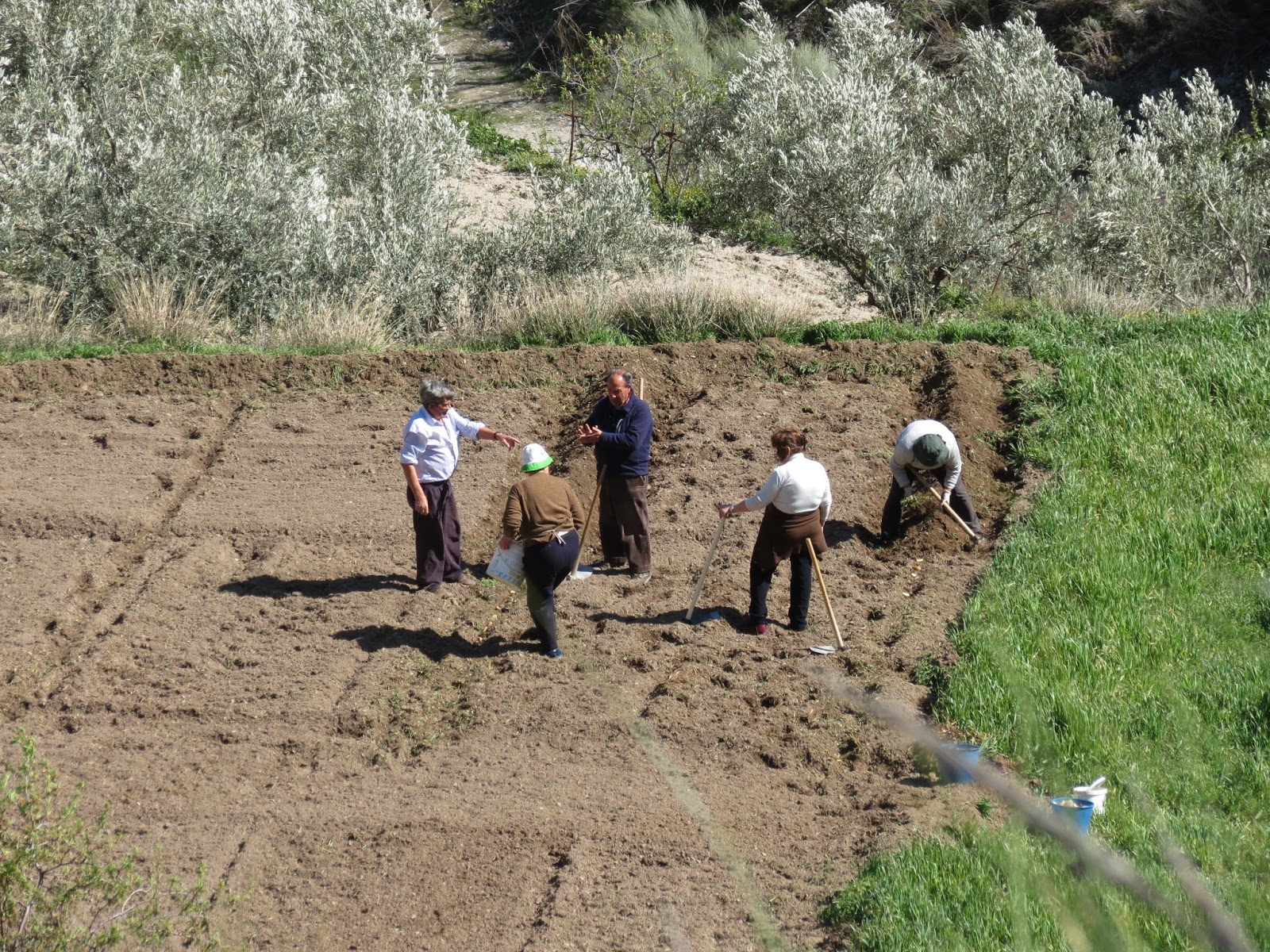
Autumn is slowly arriving and the colours of the barranco are mellowing to a golden hew, but even as I type, I can hear the small 'hand ploughs', preparing the terraced strips of land, for next springs bounty of potatoes, onions and beans.

Tuesday, 6 September 2011

So did I really see a wolf?


Most mornings, I am woken up early by the sound of a low growl. I ignore it, but soon it is followed by an impatient bark. Still I ignore it. And then I am fully stirred, when pushing home the joint assault, Holly the lurcher leaps to sit on my chest, and Millie the husky cross, starts to tug at my wrist. It’s only just getting light, so it must be time for a walk!

So off, we go, along the camino, and we soon came across Antonio, standing by the open boot of his ancient blue Fiat, parked near the track down to the first fuente.  Antonio now lives in Oria, but has spent most of his life in the Barranco, and still likes to drink the local waters. ‘Could I help him’? He wanted to fetch a couple of large bottles of water, but he had a hernia, so if he held my dogs for me, could I go and fetch some for him.
Antonio's Balsa
I went down to the fuenta to collect the water, my good deed being rewarded by the sight of blue dragon flies skimming the surface of the balsa. I also enjoyed a cool face rinse and hand cup of water from the fresh mountain spring.  Antonio and I happy, we continued on our way.

A little owl watched us with little apparent interest from its perch on the telephone wire; and over the valley, which was now out of shadow; a pair of eagles were circling on the first thermals. We surprised a couple of rabbits, but I was able to restrain the dogs, so much to their disappointment, the rabbits were able to scarper up the mountain.

A little further on, we came across Juan, Jose’s brother, down from Alicante for a few days. He was scrabbling about on the steep side of the camino, collecting something in a plastic bag from a sprawling ground plant. ‘What are you doing’, I asked? He replied that he was collecting ‘alcaparras’, and that he didn’t like them, but his wife did, but only the very small ones, after they had been pickled in vinegar and salt. Needless to say, I had to look that one up – capers!
A caper bush
Then we cut down towards the rambla. Past Katty’s, with strings of red peppers already drying in the sun. Past Isobel’s, large tomatoes ripening on vines in her small front garden and a bucket of prickly pears on her door step.; and then past Mel and Josephine’s and a friendly greeting from Ruff, their rescued Spanish Water Spaniel.


This morning we had the rambla to ourselves. We were approaching the Boca de Oria; where nearly five years ago, when we had first moved to the Barranco, we had come across Katty and her cousins from Diamuz enjoying a merienda – a picnic party, that we weren’t allowed to leave, until we’d taken a full share of the paella cooked on the open fire, and the melon cooled in the nearby fuenta, washed down of course, with copious amounts of home made wine and whiskey and coke! oh dear!

No merienda today though.

I felt a tightening of the leads and there was a low growl, but not the’ get up and come for a walk’ growl; something far more serious; and up ahead I spotted the cause for concern. Another dog maybe, but not one I’d seen around here, before or since. It was certainly not a fox, far too big. Grey and Alsatian like, but sleek, if not scrawny,  and with very long legs, that didn’t so much trot as pad, as it slinked into the undergrowth, with it’s bushy tail fixed firmly between it’s legs.
Millie and Holly -  the Wolf Slayers
So did I see a wolf? I don’t know for sure. My research says that, while their numbers in Spain are increasing, they haven’t settled here yet. However, they say the same thing about pole cats, and I definitely know I’ve seen one of those.

Friday, 1 July 2011

SIESTA


In Spain, never try to do more in a day, than is practically achievable. By this I mean, that if it involves something technical, financial, legal or medical, attempting to do any more than two things will end in failure and frustration.

Now part of this is just because it is Spain! They have a whole profession (the gestorias) devoted to understanding the bureaucracy of the nation.

The other reason is siesta! Nothing really opens until 10am and then it all shuts at 2pm, until the ‘tarde’ (5pm-8pm) ….. And we Northern Europeans like to get up once; get on with the days tasks; have some time for relaxation and then go to bed.  It is so difficult to start the day again at 5pm – especially if by then, you are thinking only of your first beer!

If you have been brought up in Spain, you will have learnt to deal with the fact that the daily rhythm involves waking up, getting up, and getting going, twice in 24 hours. Late start,; mid morning snack; late lunch; maybe some alcohol: bit of a snooze; back to work at 5pm until 8’oclock…. And then the party starts!!

Having said that, in the campo, the countryside, there is another Spanish rhythm.


It’s been getting hot these last few weeks.  When it’s not a market day, and I have to be up really early, I get the dog walking, 7am, ‘early shift’. But most often my neighbours have beaten me to start the tasks of the day. Water is torrenting down the acequia from the bolsa neuva . Isobel has been watering the newly sown corn field that will provide fodder for the goats and variety to the family pot in the autumn. All over the valley, goat herds tinkle. Millie, Holly and I nearly adopted a small herd one day, which despite the anguished cries of Maria, the goat shepherdess, wanted to come home with us! Jose has parked his donkey under the shade of an olive tree and is harvesting the first of the summers beans and onions. 


The best thing about the ‘early shift’ is that the air is really clear, and you can see miles – even to the big boats leaving  Garrucha harbour, 25k as the crow flies and 1100metres down below us.

Anyway, dogs walked, we had jobs to do in the town, and in these days of really expensive fuel, and not really wanting to go down to the town, any more than we had to anyway, we decided to ‘go for it’ and get as many jobs done as possible.

We set off over the mountain – the ‘red diesel’ guzzling, tank track tractor, was just starting to trundle over the almond groves to riddle them of weeds. Shame really, because many of those weeds were wild rocket – a peppery addition to any bland salad – though I expect to be able to find plenty more.

Sure enough, when we arrived at Albox, not the prettiest of towns, but where there has been some investment to try to improve the townscape, it was mainly shut at 9.50am!


Coffee time then! 
We found a bar and ordered 
– descafeinado for Heather, and Americano for me – and I am so glad I did. Coffee decaffeinated – why would you bother, when you could have the real thing - laced with (unasked for) brandy! ….and when I came to pay – 2 Euros! For the two including a biscuit!


The day’s looking  good – so let’s get on with it.

First a technical issue – we wanted to be able to receive Spanish TV in our casa, so into the ‘aerial and cable’ shop, around the corner from the ‘brandy’ bar, we went, to get what we needed. Sorted, no problems.

Then something financial - off to the bank, and the day started to go downhill!

I’ve had, £20 sterling in a Cajamar deposit account since we came here. At the time, it seemed like a good idea to have somewhere in Spain where I could put pound notes. Then recently, I discovered that I was being charged more for the account than I was earning in interest. I reckoned it would be about 4 years before I started to owe the bank money, and so for the second time in the month (the first attempt was aborted) I returned to the bank with what I hoped this time, would be all the correct paperwork to close the account…. And I did indeed have all the correct paperwork , but unfortunately the only employee of the bank who could close a £20 account wasn’t there, and we waited and we waited and we waited! 50 minutes later she showed up, and 10 minutes later she got around to closing the account. I tell you, I very nearly closed all the accounts we have there, but I’m sure that in the scheme of things, that was just asking for more trouble.

And then off to the gestoría for some bureaucracy. To deliver the papers of the quarter year tax return, and hopefully an explanation from the gestor, Francisco about why I was paying tax when so far this year my market stall hadn’t covered the cost of my autónomo (national health insurance) never mind make a profit! 

When we engaged him two years ago ,he could talk perfect English. Now nada! However, it took another hour of waiting to talk to him in Spanish about this, and when I left, he had my tax papers, but I was little the wiser.

…. And then it was siesta.

….and in the summer months I understand why siesta is such a necessity. It’s just too hot and knackering to do anything between 2pm and 5pm except snooze or float in a pool; though in the cooler season that’s not the case, but I guess custom is custom.

So when in Spain, remember many tasks will need to be done mañana – not tomorrow necessarily, but certainly not today!